
Five Rubber Parts Worth Standardizing First: A Ranked Shortlist for Industrial Buyers
Standardizing a rubber parts portfolio rarely fails because the buyer ran out of part numbers to cut. It usually fails because every part is treated as an interchangeable catalog line instead of a distinct risk profile. A cable grommet and a flange gasket can carry a similar unit price, yet the cost of getting each one wrong is not comparable: one is a routing accessory, the other is the last barrier between a process line and a leak.
If an industrial buyer can only standardize five rubber part families in the next planning cycle, this ranked shortlist puts them in this order: O-rings, gaskets (including sanitary gaskets), seals, grommets, and dampers. Rubber washers — the sixth family most catalogs print alongside them — are handled at the end as the part that can wait. The order reflects application fit, failure risk, and how much control a buyer gains per unit of specification effort. It does not follow catalog layout, unit price, or order volume alone.
Why catalog order is the wrong starting point
Rubber component catalogs organize by shape: O-rings in one section, washers in another, custom molded parts at the back. That structure helps a buyer find a part; it is close to useless for deciding which parts deserve a controlled specification.
The consequence is predictable. Engineering and purchasing effort flows toward the parts that are easiest to describe, not the parts that matter most. A spacer washer ends up with a drawing revision, a color reference, and a measurement plan, while an O-ring doing static sealing on a chemical line is reordered from a distributor by size alone. The parts with the highest failure consequence are frequently the worst documented.
A simpler rule works better: standardize the part whose failure is expensive and whose geometry is easy to define; postpone the part whose failure is cheap and whose geometry is already simple. That rule drives the sequence below.
What is changing in industrial rubber procurement
The low-cost end of the category carries more volume than its price suggests. A 2026 commercial market report published by Market Reports World estimated that sealing products accounted for 12% of industrial rubber consumption volume in 2024. Small parts, in other words, are where the recurring spend concentrates — and where a badly written specification repeats on every purchase order.
Material menus have widened at the same time. A seal or gasket that was once simply 'rubber' is now a geometry plus a qualified compound family: NBR for oils, EPDM for water and weather, silicone for temperature and clean applications, FKM for aggressive chemical and heat duty, HNBR where heat, oil, and mechanical strength are needed together. Each choice answers a different media and duty question, which means a standard part nowadays means a standard drawing plus a defined compound, not a shape alone.
Compliance language has also become more specific, and less forgiving. Food-contact and medical references are routinely listed side by side even though they are not interchangeable: FDA 21 CFR 177.2600, USP Class VI, and ISO 10993 address different questions, a distinction that industry technical guidance from Wayne Rubber states explicitly. A specification that names only 'food-grade silicone' without naming the compound grade and the test basis is a placeholder, not a standard.
How this ranked shortlist was built
Each of the six common families was weighed against five qualitative criteria:
- Consequence of failure — does a failed part stop a line, contaminate a product, or create a safety or compliance event?
- Repeat volume — how often the part is reordered, and therefore how much value sits in the specification itself.
- Definition effort — how completely the part can be captured with a drawing, a hardness band, and a compound callout.
- Compliance exposure — whether food, medical, sanitary, or automotive documentation is part of the purchase.
- Tooling and inspection cost — how much of the standardization benefit is consumed by tooling changes and measurement.
The weighting is deliberately qualitative. This is an editorial prioritization for buyers planning a standardization program, not a market ranking of products or suppliers, and no family is universally superior to another. A buyer whose dominant risk sits elsewhere — for example, a single high-value vibration isolation assembly — may reasonably reorder the list.
The shortlist is written from a molder's perspective. Longrun Rubber Products (Huizhou) Co., Ltd. is a custom molded rubber parts manufacturer established in China in 2005, operating a 10,000 m² facility in Huizhou, Guangdong, with 120 employees and a 20-engineer engineering team; roughly 80% of its output is exported. Its stated product scope — rubber seals, gaskets, O-rings, grommets, dampers, and washers — is the same six families evaluated here.
1. O-rings: the highest standardization return per engineering hour
O-rings rank first because they combine a small unit price with a sealing function that fails loudly. A toroidal ring is dimensionally simple, it works in both static and dynamic sealing applications, and the same geometry repeats across hundreds of joints. That combination makes the specification effort cheap and the payoff immediate: one approved size and compound record can cover many assembly points.
Compound choice is the part of the O-ring decision that most often goes undocumented. A practical mapping for industrial buyers:
- NBR — petroleum-based oils, fuels, and greases; the default where oil-side sealing dominates and weather exposure is limited.
- EPDM — water, steam, and outdoor exposure with ozone and ultraviolet resistance; generally not the choice for petroleum oils.
- FKM — higher temperature combined with aggressive chemical duty; a higher cost tier that should be justified by the media, not by habit.
- Silicone — broad temperature flexibility and clean applications where the compound grade suits food or medical use; generally lower tear and abrasion resistance, so it is a poor fit for high-friction dynamic duty.
- HNBR — heat plus oil plus mechanical strength in harder-working dynamic joints.
What to standardize: a defined size series tied to the groove dimensions actually used in the plant, a durometer band per application class, one compound family per media group, and a single documentation package. What to check on receipt: dimensions against the drawing, hardness, compression behavior appropriate to the joint, and visual acceptance.
One boundary matters. A material label such as 'FKM' or 'silicone' describes a family, not a proven service limit. The temperature and media envelope for a specific compound has to be confirmed for that compound, ideally by test, before it becomes a plant standard.
2. Gaskets, including sanitary gaskets: where compliance meets geometry
Gaskets rank second because they merge two risks that are handled by different departments. The geometry is custom — flange patterns and port sizes rarely repeat across equipment — and the material decision often sits inside a food, medical, or sanitary compliance path where a leak is not the only failure mode.
Sanitary gaskets used on food, beverage, and pharmaceutical process lines deserve their own sub-family inside the standard rather than a generic gasket note. For those parts the specification question is not only 'does it seal' but 'what is it made of, and what can the supplier document'. Common compound directions follow the same logic as O-rings: EPDM for water, steam, and weather-exposed service; silicone for clean, temperature-stable lines where the grade supports food or medical use; FKM for chemical and higher-temperature duty; NBR for oil-side industrial flanges.
The standardization lever here is a material and tolerance framework rather than a single part number: approved compound grade, thickness, hardness, surface finish, a tolerance band per feature, and the compliance record matched to the standard the buyer actually needs. Acceptance should test both halves of that framework — physical dimensions and hardness on one side, the material record on the other.
3. Custom seals: standardize the architecture, not every profile
Seals — lip seals, profile seals, and rubber-to-plastic bonded seals — rank third because they carry the most engineering content of the three sealing families. Every new profile is a new tool, so a part-by-part standardization attempt stalls quickly.
The useful move is architectural. Standardize a small number of profile families, a bonding method, a fixed compound set, and one test protocol, then let individual part numbers live inside that framework. A documented automotive example shows what a controlled result looks like in practice: a US automotive rubber parts OEM project running at 1,000k units per year for five years recorded tensile strength of at least 7 MPa, elongation at break of at least 400%, tear strength of at least 15 kN/m, Cpk above 1.33, a defect rate below 150 ppm, precise dimensions, and firm rubber-to-plastic bonding. Those figures describe that project; they are not a default promise for a different profile or application.
For buyers, the architectural approach reduces the number of approval cycles and keeps compound decisions consistent across a product family — which matters more than shaving a profile dimension.
4. Rubber grommets: high volume, low definition effort
Rubber grommets rank fourth. They are cheap, they are usually a protective rather than a sealing function, and their failure is rarely catastrophic — but they are extremely numerous, which is exactly what makes them worth standardizing early. A grommet can be fully described by a panel thickness range, a cable or harness diameter range, a compound, and a color, so the specification effort is low and the consolidation benefit arrives quickly.
The volume argument is visible in market data: the same Market Reports World report estimated that grommets held a 36.45% share of the automotive rubber molding segment in 2025, driven by routine cable and harness protection. High automotive volume also explains why liquid silicone rubber capacity keeps expanding — Credence Research projected the global LSR market growing at a CAGR of 8.7% to reach USD 6.5 billion by 2033 — and why grommet specifications increasingly mix EPDM for weather-exposed body locations, silicone for heat-adjacent routing, and NBR where oil is present.
What to standardize: panel thickness bands, cable diameter bands, compound per environment, and color coding for harness identification. Acceptance is mostly dimensional and visual, with insertion behavior verified in the actual panel.
5. Rubber dampers: standardize the test, not the geometry
Rubber dampers rank fifth among the five, not because they matter least but because their performance is the hardest to standardize as a catalog item. Damping depends on geometry, hardness, attachment method, and the mass and frequency of the system it sits in, so a cross-machine 'standard damper' is rarely meaningful.
What can be standardized is the process around them: an approved hardness band, a defined bonding method for metal or plastic inserts, a fixed test method, and acceptance limits agreed before the first production lot. A second documented project shows the pattern — a US food, medical, machinery, and sanitary application running at 3,000k units per year for five years, used for vibration and noise reduction, cushioning and protection, dustproof and waterproof protection, and resistance to heat and chemicals, with recorded tensile strength of at least 8 MPa, elongation at break of at least 450%, tear strength of at least 35 kN/m, Cpk above 1.33, defect rate below 150 ppm, and precise dimensions. Again, those values are a record of that project and a realistic reference point for discussion, not a specification template for another machine.
The sixth family: why rubber washers can wait
Rubber washers sit outside the top five for one reason: in most uses they are a seating, spacing, or cushioning element with a low failure consequence and a simple geometry that is easy to re-source later. Standardizing them early consumes effort without buying much risk reduction.
There are clear exceptions. If a washer sits in a chemical or food-contact path, or provides electrical insulation — a legitimate function for rubber compounds formulated for high insulation or conductivity — the failure consequence rises and the washer should move up the list. Because washers are already inside the same supplier scope and appear on the same quality certificates as the other families, adding them in a later phase does not force a second sourcing program.
Side-by-side: the five-part standardization shortlist
| Rank | Part family | Why it earns this position | Standardize first | Material shortlist |
|---|---|---|---|---|
| 1 | O-rings | Simple geometry, sealing function, very high repeat volume | Size series, durometer band, compound per media | NBR, EPDM, FKM, silicone, HNBR |
| 2 | Gaskets and sanitary gaskets | Custom geometry plus food, medical, or sanitary documentation | Compound grade, thickness, hardness, tolerance band, compliance record | EPDM, silicone, FKM, NBR |
| 3 | Seals (profile and bonded) | Highest engineering content, new tooling per profile | Profile families, bonding method, fixed compound set, one test protocol | NBR, HNBR, FKM, silicone |
| 4 | Grommets | High volume, low definition effort, fast consolidation | Panel and cable diameter bands, compound per environment, color coding | EPDM, silicone, NBR |
| 5 | Dampers | System-dependent performance; process is standardizable, geometry is not | Hardness band, bonding method, test method, acceptance limits | EPDM, NBR, silicone, HNBR |
| Later | Washers | Low failure consequence and simple geometry in most uses | Defer unless chemical, food, or insulation duty applies | NBR, EPDM, silicone |
Custom options worth writing into the drawing
Standardization collapses the moment the drawing leaves the customization open. Four variables carry most of the risk:
- Hardness — specify the durometer scale and a tolerance band, not a single number. Hardness changes sealing force in O-rings and gaskets and changes stiffness in dampers and grommets, so it drives function more directly than most dimensional notes.
- Dimensions and tolerances — reference the drawing revision on every order and set tolerances per critical feature rather than a blanket note. A general tolerance that satisfies a spacer can fail a sealing groove.
- Color — define a master chip or reference and require batch consistency. Where color is functional, such as harness identification in grommets, treat a color shift as a defect, not a cosmetic variation.
- Physical properties — tensile strength, elongation at break, tear strength, and compression behavior. Choose the two or three that govern the application and leave the rest to the compound datasheet; specifying everything dilutes the acceptance decision.
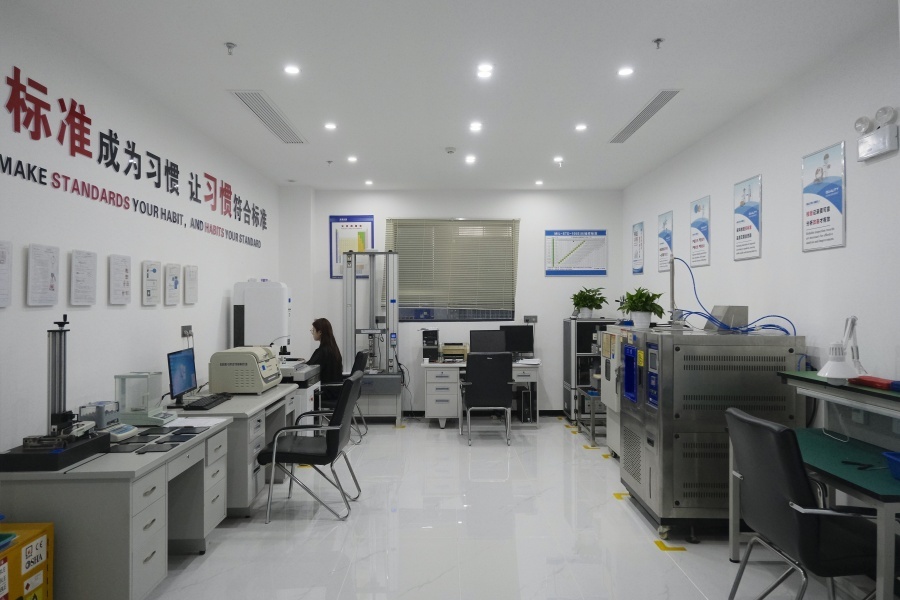
These options are all within normal custom molding practice. Longrun Rubber Products supports them through custom rubber molding, silicone molding and silicone injection molding workshops, in-house mold storage, trimming, and 100% testing, under OEM production, with a stated lead time of 20 days and MOQ and monthly capacity set according to customer requirements.
Purchasing terms and acceptance criteria that make standardization stick
A ranked shortlist only pays back when the purchase order carries the same discipline as the engineering decision. The clauses that matter most:
- Drawing revision and compound designation on the PO. A part number without a revision invites silent substitution.
- A written acceptance method. Name which dimensions are measured, on what sampling basis, and by whom — supplier, buyer, or both.
- A material record matched to the actual standard. Not a generic 'food grade' or 'medical grade' label, but the documentation for the specific compound against the specific requirement.
- Tooling ownership and change control. Agree who owns the mold, and require notification before any compound or process change.
- Lead time planning. A 20-day production lead time is a working planning figure; new tooling and first-article approval sit outside it and should be scheduled separately.
- After-sales terms. Warranty and returns, plus technical assistance, should be stated in the agreement rather than discovered during a quality event.
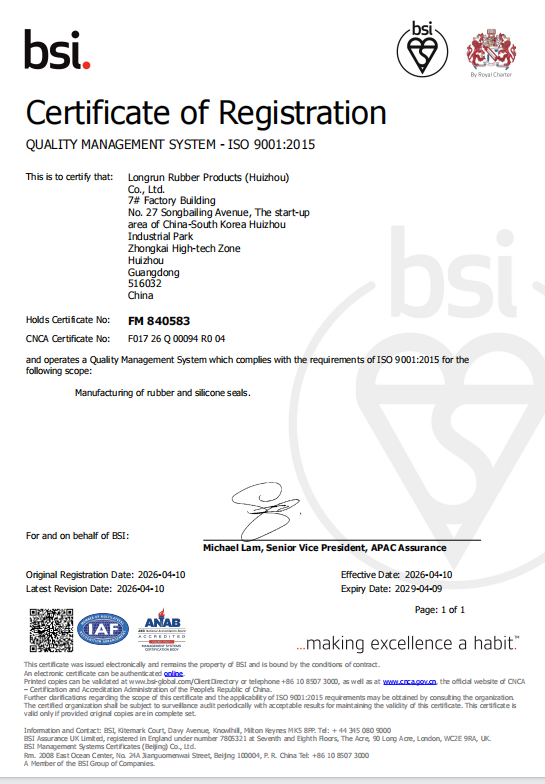
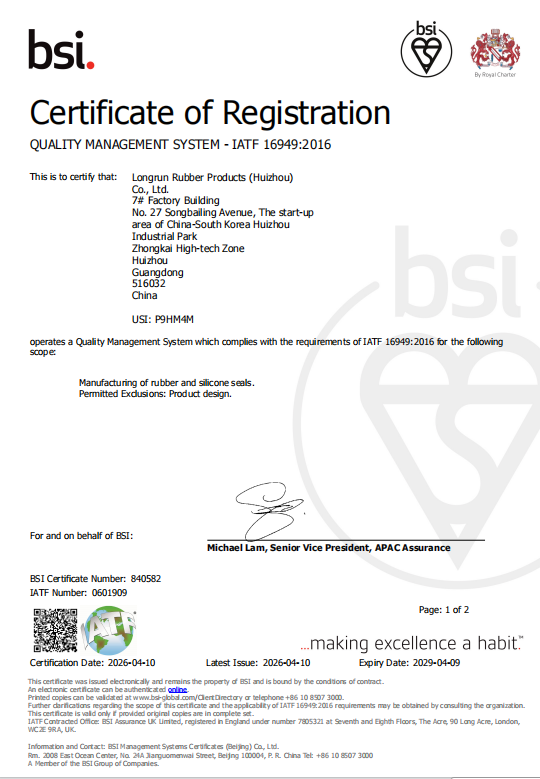
Certificate scope deserves a specific note here. Longrun Rubber Products holds ISO 9001:2015 (BSI certificate FM 840583) and IATF 16949:2016 (BSI certificate 0601909), both issued on 10 April 2026 and valid to 9 April 2029, with a scope covering the manufacturing of rubber and silicone seals. That is a quality management scope. It supports a supplier qualification decision, but it does not by itself certify any individual compound as food-contact compliant or biocompatible — that evidence has to be requested per material.
How the shortlist plays out by industry
The sequence shifts slightly by sector, though the underlying logic does not:
- Automotive — grommets and dampers tend to lead on volume, with bonded seals close behind. Automotive buyers carry an additional supplier requirement, which is why an IATF 16949 scope is often screened before samples are requested.
- Medical and food processing — sanitary gaskets and silicone parts move to the front, because documentation, not price, decides approval. The compound record is the deliverable.
- Industrial machinery — O-rings and profile seals dominate, typically in NBR or EPDM, with FKM reserved for aggressive media.
- Electrical and electronics — grommets and insulating washers gain weight, particularly where a compound is selected for high insulation or conductivity rather than mechanical properties.
- Energy and process equipment — FKM and HNBR seals take priority because heat and chemical exposure raise the cost of a sealing failure sharply.
Frequently asked questions
Which compliance documents should a buyer request for food-contact or medical rubber parts?
Request the documentation for the specific compound against the specific requirement, because the common references are not interchangeable. FDA 21 CFR 177.2600 addresses food contact, USP Class VI addresses biological reactivity, and ISO 10993 addresses biocompatibility; industry guidance from Wayne Rubber notes that these standards are frequently cited together but are not equivalent. Pair the material record with the supplier's quality management scope — for Longrun, ISO 9001:2015 and IATF 16949:2016 covering the manufacturing of rubber and silicone seals — and confirm which document applies to your end use before approving the part.
Can one supplier standardize all five families at once?
It is feasible where the supplier's scope already covers the full set. Longrun Rubber Products manufactures custom molded rubber parts including seals, gaskets, O-rings, grommets, dampers, and washers, and works across NBR, EPDM, silicone, FKM, and HNBR compounds, with a 20-engineer team, in-house mold storage, silicone injection molding, trimming, and 100% testing. Buyers should still verify each family separately with a sample, since capability breadth does not remove the need for part-level approval.
What drives cost when standardizing a rubber part?
Four factors dominate: tooling, compound tier, tolerance and inspection level, and volume. Moving from NBR or EPDM to FKM or HNBR raises material cost, and tightening tolerances raises inspection cost more than many buyers expect. Standardization reduces total cost by consolidating tooling and inspection across fewer part numbers, not by downgrading the compound — a cheaper material that fails the media test is the most expensive option in the program. MOQ and monthly capacity are typically set according to customer requirements rather than fixed tiers.
How should a sample approval run before a blanket order?
Approve against the drawing revision, not against a photograph. Measure the critical dimensions, confirm hardness and color against the agreed reference, and run the part in the real assembly before signing off. Keep the approved sample and its measurement record as the reference for future lots, and discuss process capability explicitly — two documented Longrun projects recorded Cpk above 1.33 and defect rates below 150 ppm, which is a useful benchmark for that conversation rather than a default commitment for a new part.
What lead time should we plan for?
Longrun states a 20-day production lead time, which is a reasonable planning figure for repeat orders of an approved part. New tooling and first-article approval sit outside that window and should be scheduled as a separate phase, particularly for seals and dampers where the geometry is application-specific. Planning the two phases separately prevents the most common schedule failure in a standardization program: treating an unapproved part as if it were a repeat order. Buyers who want to move faster can request samples or a quotation against their drawing, and the company brochure is available as a downloadable PDF.
Conclusion
The order that produces the most control per unit of effort is O-rings first, then gaskets and sanitary gaskets, then seals, then grommets, then dampers, with washers deferred until a chemical, food, or insulation duty pulls them forward. Each step in that sequence follows the same rule: standardize the part whose failure is expensive and whose geometry is easy to define.
What makes the program hold together afterwards is less glamorous than the ranking. A drawing revision on the purchase order, a compound designation that matches the media, an acceptance method that both sides understand, and compliance documentation matched to the actual standard will do more for supply stability than any further part-number reduction. Buyers who apply those four controls to the first two families usually find the remaining three easier to approve — and the washer file can wait without costing anything.
Have Questions or Need More Details?
Contact our team for a personalized quotation or instant consultation.
Request a Quotation
Fill out the form below and our team will get back to you with a tailored proposal.
WhatsApp Direct Chat
Prefer to chat in real-time? Message us on WhatsApp for instant assistance & quick answers.
- Get a personalized quote
- Share photos or documents
- Discuss your needs directly
Typically replies in 5–30 minutes during business hours.