
FKM vs. HNBR Rubber Gaskets: A Head-to-Head Decision for Chemical and Heat Resistance
FKM vs. HNBR Rubber Gaskets: A Head-to-Head Decision for Chemical and Heat Resistance
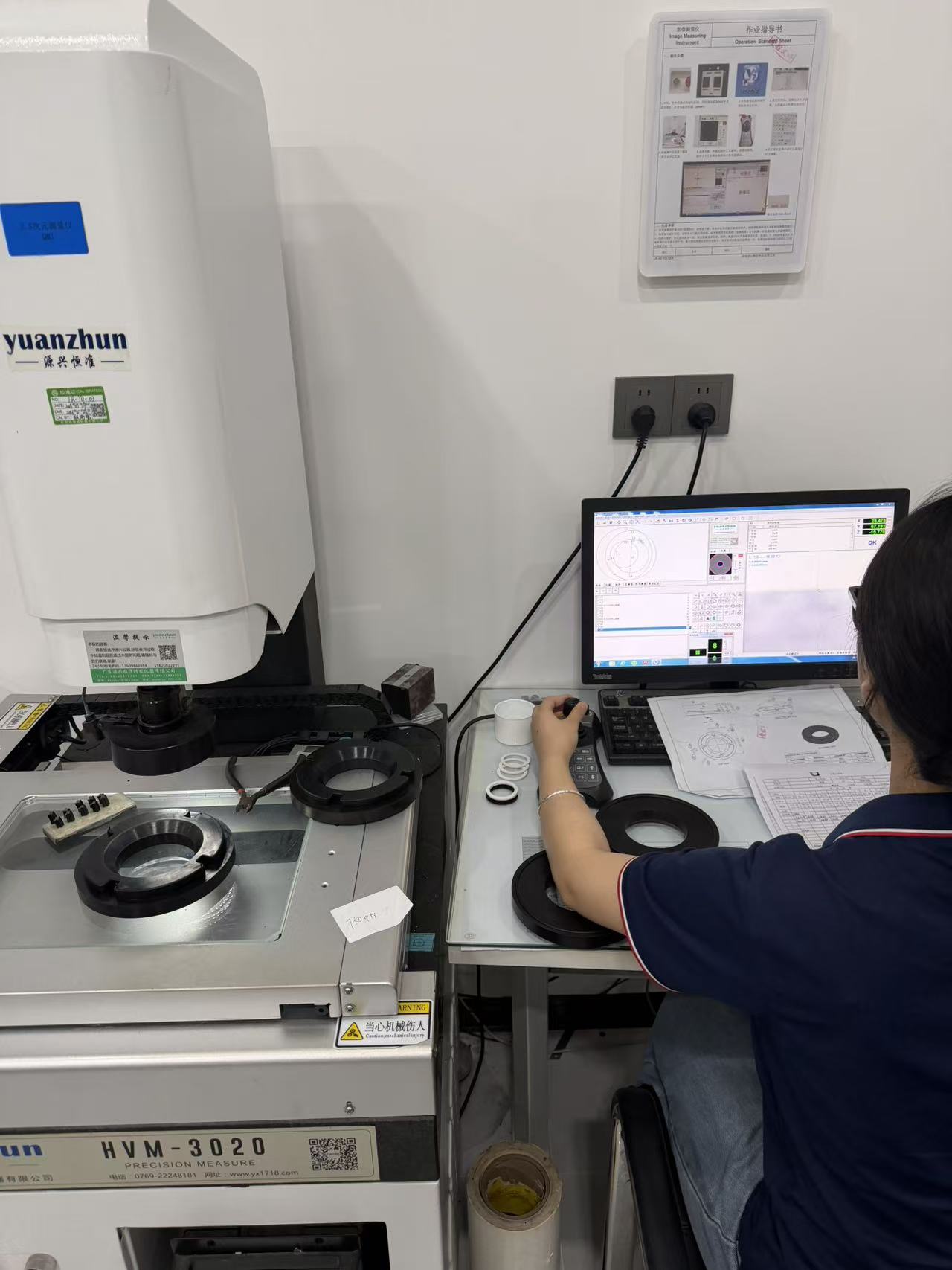
When a gasket has to hold a seal under both aggressive media and sustained heat, the shortlist almost always narrows to two elastomers: FKM (fluoroelastomer, commonly referenced by the trade name Viton) and HNBR (hydrogenated nitrile rubber). The practical rule: FKM is the usual first choice where the media list is chemically aggressive — fuels, solvents, aggressive oils and harsh process chemicals — while HNBR is the usual first choice for oil, ozone and elevated-temperature service where a more balanced cost-performance profile is enough. Both compounds are listed among the custom materials Longrun Rubber Products (Huizhou) Co., Ltd. offers for its chemical-resistant and high-temperature gasket families, and neither is a drop-in substitute for the other.
This comparison is written for buyers in the evaluation-to-execution stage — engineers and procurement managers who have already narrowed the shortlist to FKM and HNBR and now need to defend the decision, write a specification, and move into sampling and production. It covers what actually separates the two compounds, where each one is the right fit across automotive, industrial and energy applications, where both are the wrong answer, and how hardness, dimensions and physical properties are customized once the material choice is locked.
The Real Problem: "Chemical Resistant" Is a Claim, Not a Specification
Material sheets for FKM and HNBR both carry the phrase “chemical resistant”, and that is precisely where evaluation goes wrong. The phrase says almost nothing about the decision that matters: which media, at what concentration, at what temperature, for how long, and under what compression. Three failure patterns follow from that gap.
- Over-specification. FKM is selected by default because it “sounds stronger”, and the program pays a higher compound cost for chemical resistance the application never uses.
- Under-specification. HNBR is selected for cost reasons on a genuinely aggressive media, and the seal fails early — typically as compression set, swelling, or a slow leak that only appears after thermal cycling.
- Unverifiable comparison. Two suppliers quote “chemical resistant FKM” and “chemical resistant HNBR” against test conditions that are never stated, so the comparison cannot be reproduced or audited.
The useful question is therefore not “which material is better” but “which compound matches this media list, this temperature and pressure envelope, this sealing geometry, this certification requirement and this annual volume”. Longrun Rubber Products (Huizhou) Co., Ltd., a custom rubber molded parts manufacturer established in China in 2005, lists both FKM/Viton and HNBR within the same gasket and seal material set — which means the comparison can be run against one manufacturing and quality system instead of two.
Industry Background: Why Compound Selection Is Getting More Scrutiny
The global industrial rubber product market was valued at USD 28.28 billion in 2024 and is projected to reach USD 45.19 billion by 2034, according to Zion Market Research. That number should be treated as directional rather than exact: published estimates for the same category differ substantially because some research houses include tires and others exclude them, with Fortune Business Insights and Future Market Insights reporting materially different totals for overlapping scope. The direction is consistent — engineered rubber components remain an expanding category, and sealing components are a significant part of it.
Trade flows matter for the same reason. China exports approximately EUR 4.01 billion in rubber products to the European Union annually. For a European or North American buyer, an FKM or HNBR gasket decision is therefore usually a cross-border sourcing decision, which turns compound consistency into an operational question as much as a technical one. The raw-material base behind both compounds is concentrated among major synthetic rubber producers including Sinopec, Arlanxeo and ExxonMobil, according to MarketsandMarkets — so supplier qualification should cover how a molder controls incoming compound, not only which material name appears on the drawing.
Three standards anchor the technical conversation. ASTM D2000 is the primary classification system for rubber products in automotive and industrial applications, and it is the normal vehicle for converting “FKM or HNBR” into a purchasable line call. ISO 3302-1 defines dimensional tolerances for molded, extruded and calendered rubber products. FDA 21 CFR 177.2600 specifies the requirements for rubber articles intended for repeated use in food-contact applications. A defensible FKM vs. HNBR decision touches all three.
Capability Profile: What Each Compound Actually Brings to a Gasket
FKM (Viton)
FKM is a fluoroelastomer, frequently referenced by the trade name Viton. It is generally the compound buyers reach for when the media list is aggressive — fuels, aggressive oils, solvents and harsh process chemicals — and when that chemical exposure is combined with continuous heat. In Longrun's rubber gasket range, FKM (Viton) is listed as a custom material option inside families that include oil-resistant gaskets, chemical-resistant gaskets and high-temperature gaskets, and the same material is available across the company's rubber seals, rubber O-rings, rubber washers, rubber grommets and rubber dampers.
The trade-off is commercial as much as technical: FKM is generally the higher-cost compound, so the right question is not “can we use FKM?” but “does the media require FKM?”. Where it does, the cost is justified; where it does not, over-specifying FKM is one of the most common ways to raise unit cost without improving seal life.
HNBR
HNBR is hydrogenated nitrile rubber — a nitrile (NBR / Buna-N) chemistry that has been hydrogenated to improve resistance to heat, ozone and ageing. In practice it sits above standard nitrile on durability while remaining a chemical-resistant gasket material in its own right, which is why Longrun lists HNBR both as a custom gasket material and as an option within oil-resistant and chemical-resistant gasket types.
HNBR is usually the more balanced selection: it handles oil, ozone and elevated-temperature service, and it does so at a compound cost below FKM. What HNBR does not do is replace FKM in the most aggressive chemical media. When that boundary is crossed, the specification has to change compound — increasing hardness is not a substitute for changing chemistry.
What Stays the Same Regardless of Compound
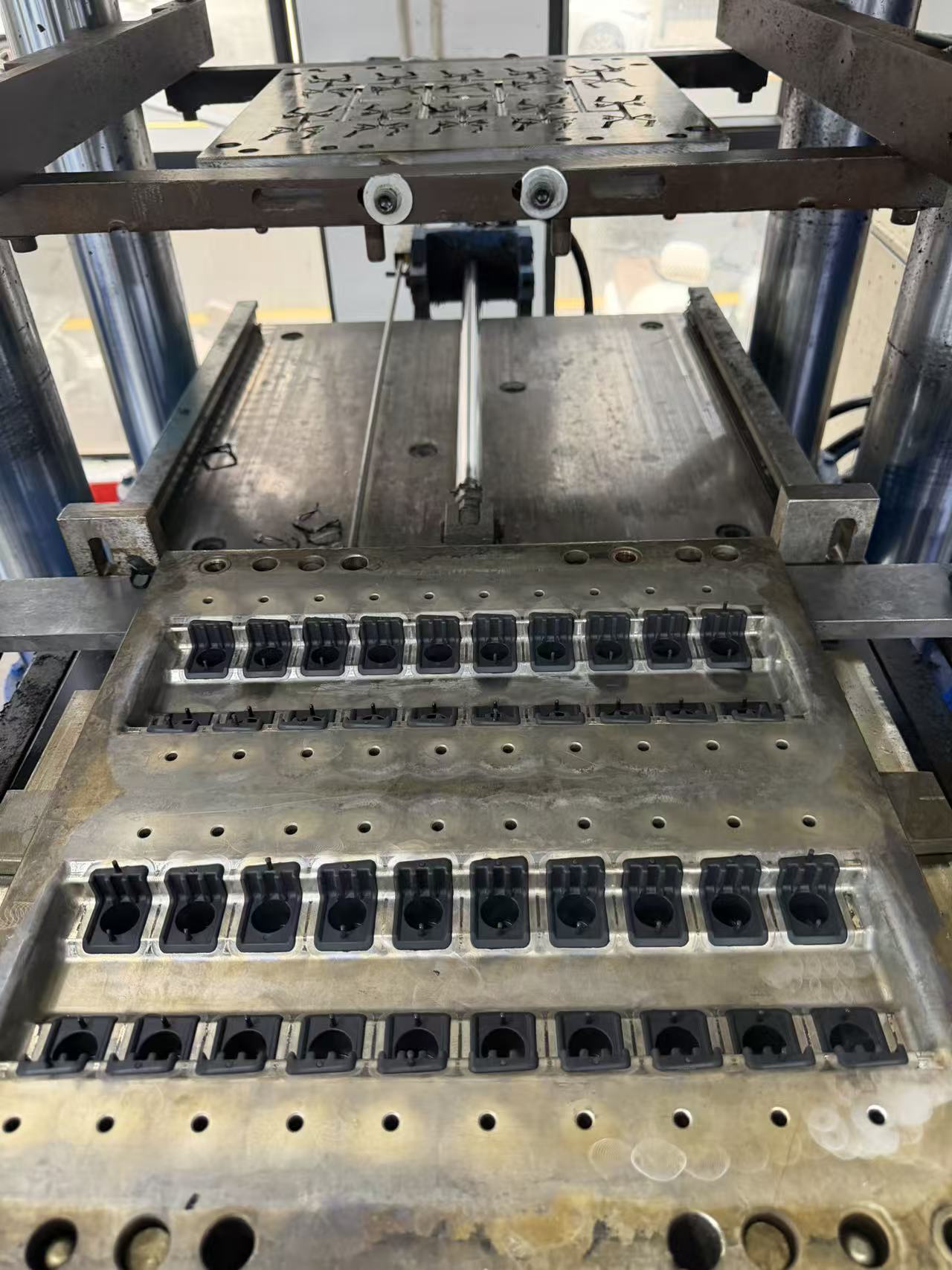
Whichever compound is chosen, the manufacturing and quality model at Longrun does not change. Gaskets and seals are supplied as custom-made parts: hardness, dimensions, color and physical properties are built to the buyer's requirement rather than to a fixed catalogue grade. The gasket range covers oil-resistant, chemical-resistant, high-temperature, low-temperature/cryogenic, food-grade/FDA-approved, medical-grade and high-pressure/flange types, and the underlying material set — EPDM, NBR/Buna-N, NR, CR/Neoprene, FKM/Viton, SBR, HNBR and silicone rubber, including medical-grade silicone — is shared across the wider product family of seals, O-rings, washers, grommets and dampers. Switching compound after a failed validation therefore does not mean switching supplier and re-qualifying a new tooling base.
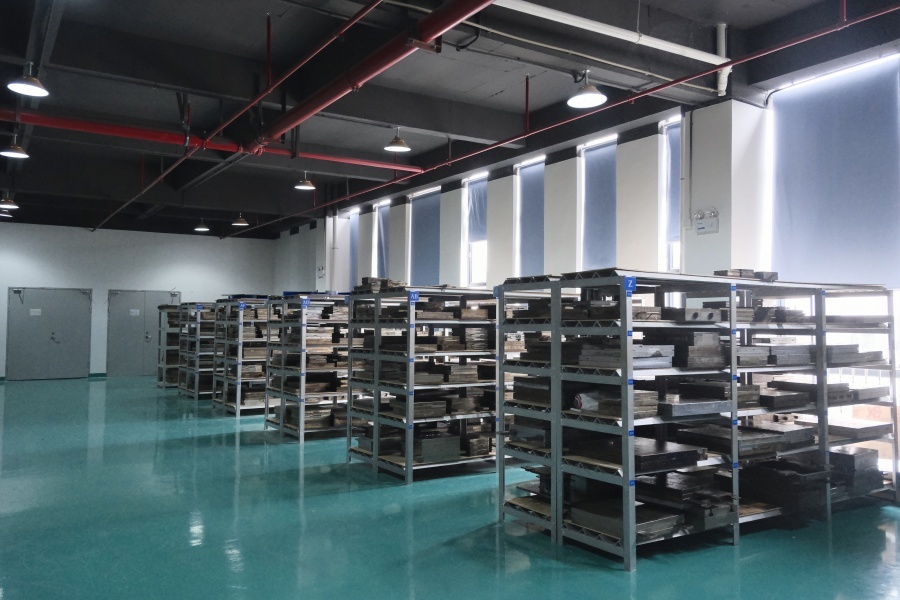
The operation behind that range is a 10,000 m² manufacturing site established in 2005, with 120 employees including a 20-engineer R&D team. Production is OEM-oriented, output is 100% tested, and approximately 80% of product is exported to global markets. For an FKM vs. HNBR evaluation, the relevant capability is not the material list itself but the ability to hold a specification constant across compound, tooling and volume.
FKM vs. HNBR at a Glance
The table below compares the characteristics that drive a real gasket decision. Because both materials are supplied as engineered compounds rather than fixed catalogue grades, published property charts rarely describe the exact compound a buyer will receive — final numbers must come from the line call and the validation test plan for the specific program.
| Decision Dimension | FKM (Viton) | HNBR |
|---|---|---|
| Compound family | Fluoroelastomer; commonly referenced by the trade name Viton | Hydrogenated nitrile rubber, derived from NBR / Buna-N chemistry |
| Why buyers usually specify it | Chemically aggressive media — fuels, aggressive oils, solvents, harsh process chemicals | Oil, ozone and elevated-temperature service where a balanced profile is sufficient |
| Heat positioning | Selected when continuous heat resistance is a primary requirement; sits inside the high-temperature gasket family | Selected for elevated-temperature oil and ozone exposure; a step above standard nitrile |
| Main trade-off | Generally the higher-cost compound; justified only when the media demands it | More balanced cost-performance, but not the default for the most aggressive chemical media |
| Availability at Longrun | Listed as a custom material for rubber gaskets and rubber seals | Listed as a custom material for rubber gaskets and rubber seals |
| Customization variables | Hardness / dimensions / color / physical properties, made to requirement | Hardness / dimensions / color / physical properties, made to requirement |
| Specification hooks | ASTM D2000 line call; ISO 3302-1 tolerances; FDA 21 CFR 177.2600 where food contact applies | ASTM D2000 line call; ISO 3302-1 tolerances; FDA 21 CFR 177.2600 where food contact applies |
| Typical industries served | Automotive / Industrial / Machinery / Energy / Medical / Food / Electrical | Automotive / Industrial / Machinery / Energy / Medical / Food / Electrical |
Reading the table correctly: FKM and HNBR are not ranked here. The two columns describe different jobs. A gasket program that picks the stronger-sounding material without matching it to the media list, temperature profile and duty cycle is making a cost decision disguised as a technical one.
Step-by-Step: How to Specify and Qualify the Choice
- Document the exposure, not the material. List every medium the gasket will contact, including cleaning agents and lubricants, with concentration and contact duration. Add the temperature range (continuous and peak), the pressure, and whether the seal is static or dynamic. This document, not a material name, is what a molder can engineer against.
- Fix the gasket type family first. Longrun's range separates oil-resistant, chemical-resistant, high-temperature, low-temperature/cryogenic, food-grade/FDA-approved, medical-grade and high-pressure/flange gaskets. Choosing the family narrows the compound question before any supplier discussion begins.
- Convert the requirement into an ASTM D2000 line call. ASTM D2000 is the primary classification system for rubber products in automotive and industrial applications. A line call formalizes hardness, tensile strength, elongation and heat-age requirements as a comparable specification rather than a verbal preference.
- Set the dimensional basis. ISO 3302-1 defines tolerances for molded rubber products. Because gasket sealing depends on compression, tolerance class must be agreed before tooling is cut — not after first article.
- Confirm the regulatory path. Map the application to the standards that apply: IATF 16949 for automotive quality management, ISO 9001 for general manufacturing quality, and FDA 21 CFR 177.2600 where the article is intended for repeated use in food contact.
- Prototype, validate and define acceptance up front. Build the first article, verify dimensions and properties against the line call, and agree how shipment will be accepted. Longrun's stated acceptance policy supports pre-shipment testing, with third-party inspection usually appointed by the client.
- Ramp with the specification frozen. OEM production runs with 100% testing, MOQ determined by customer requirement, and a stated lead time of 20 days. Warranty and returns plus technical assistance are part of the supply agreement, which matters when a compound is later questioned in the field.
Use Cases: Where Each Material Fits
Automotive
Automotive is the classic FKM territory: fuel, oil and hot-engine environments reward chemical resistance combined with heat stability, and ASTM D2000 gives engineering teams a shared language across OEM and tier suppliers. HNBR also has a legitimate place in automotive — particularly where oil, ozone and elevated-temperature exposure dominate and a more economical compound meets the requirement. In one US automotive rubber parts OEM program, Longrun supplied parts for shock absorption and noise reduction, sealing and leakage prevention, conveying media, and protection of transmission components, reaching tensile strength ≥ 7 MPa, elongation at break ≥ 400% and tear strength ≥ 15 kN/m. That five-year program runs at 1,000,000 units per year with Cpk > 1.33, a defect rate below 150 ppm, precise dimensions and firm rubber-to-plastic bonding.
Industrial, Machinery and Energy
In machinery, pumps, compressors and process lines, the deciding variable is usually the media list rather than the temperature alone. A gasket exposed to aggressive process chemicals plus heat moves toward FKM; a gasket in oil-lubricated, ozone-exposed machinery service with moderate chemical contact is often well served by HNBR. For energy applications, the same logic applies to flanges, housings and pipe connections, where high-pressure/flange gasket types and consistent compression matter as much as the compound itself.
Food, Medical, Machinery and Sanitary
Regulated industries raise the stakes because sealing failure is both a performance and a compliance event. A US-based program serving Food, Medical, Machinery and Sanitary clients has run for five years at 3,000,000 units per year, with the product used for vibration and noise reduction, cushioning and protection, dustproof and waterproof protection, and resistance to heat and chemicals. Verified results on that program reached tensile strength ≥ 8 MPa, elongation at break ≥ 450% and tear strength ≥ 35 kN/m, with long lifespan, Cpk > 1.33, defect rate below 150 ppm and precise dimensions. Where food contact applies, FDA 21 CFR 177.2600 is the reference standard for rubber articles intended for repeated use.
When Neither FKM nor HNBR Is the Right Answer
Both compounds can be the wrong specification. For outdoor weathering, water, steam and general-purpose sealing, EPDM is frequently the more sensible choice — the EPDM rubber market was estimated at USD 10.54 billion in 2024, driven significantly by the automotive and construction sectors (Market Research Future), which is a reminder that a large share of gasket demand never requires FKM or HNBR at all. Longrun's custom material set also includes NBR/Buna-N, natural rubber, CR/Neoprene, SBR and silicone rubber, including medical-grade silicone. If the media list falls outside both FKM and HNBR, the correct move is to change compound within a qualified supplier's range rather than push either material past its envelope.
Compliance and Proof: What to Verify Before You Commit
For buyers moving from evaluation into execution, certification is the fastest way to test whether a supplier can carry an FKM or HNBR program at production scale. Longrun holds ISO 9001:2015 certification (certificate FM 840583, issued by BSI) and IATF 16949:2016 certification (certificate 0601909, also issued by BSI). Both certificates carry the scope “manufacturing of rubber and silicone seals”, were issued on 10 April 2026 and expire on 9 April 2029.
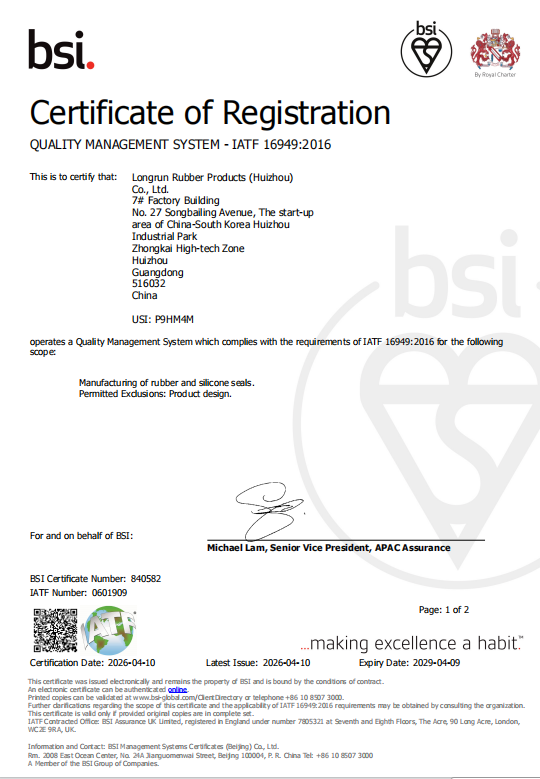
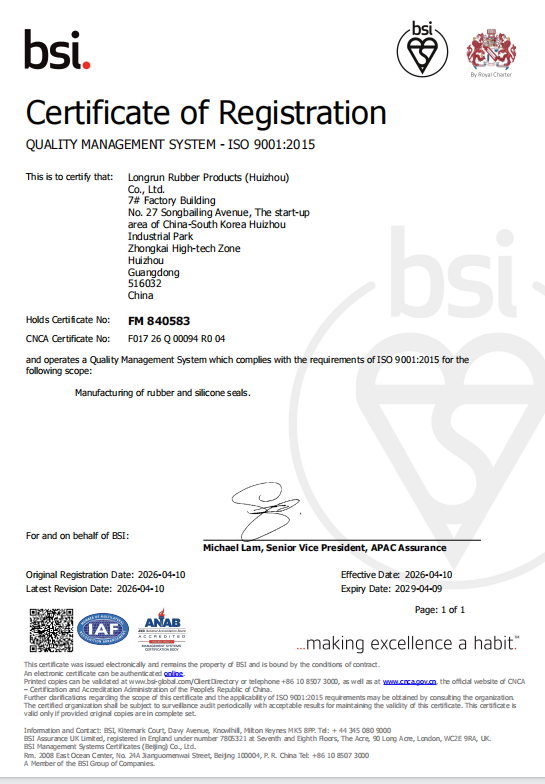
Certification is the entry ticket, not the proof. Production evidence is what distinguishes a supplier that can hold a specification: Cpk > 1.33 and defect rates below 150 ppm on multi-year programs, 100% testing on output, and an acceptance route that allows pre-shipment testing and client-appointed third-party inspection. Ask for those records against the gasket family you are buying, not against the company in general.
FAQ: FKM vs. HNBR Gaskets for Chemical and Heat Resistance
Are FKM and HNBR gaskets covered by industry certification?
Yes. Longrun Rubber Products (Huizhou) Co., Ltd. holds ISO 9001:2015 certification (certificate FM 840583, issued by BSI) and IATF 16949:2016 certification (certificate 0601909, also issued by BSI), both with the scope “manufacturing of rubber and silicone seals”, issued on 10 April 2026 and valid until 9 April 2029. The IATF certificate is the automotive quality management standard, which is why both compounds can be specified for automotive sealing programs. Where rubber articles are intended for repeated use in food contact, FDA 21 CFR 177.2600 is the applicable reference standard, and ASTM D2000 provides the classification framework for automotive and industrial rubber products.
Can FKM and HNBR gaskets be customized in hardness, dimensions and physical properties?
Yes. Longrun supplies rubber gaskets and rubber seals as custom-made parts rather than fixed catalogue grades: hardness, dimensions, color and physical properties are produced to the buyer's requirement. FKM (Viton) and HNBR both appear on the material list alongside EPDM, NBR/Buna-N, natural rubber, CR/Neoprene, SBR and silicone rubber, including medical-grade silicone. The gasket range covers oil-resistant, chemical-resistant, high-temperature, low-temperature/cryogenic, food-grade/FDA-approved, medical-grade and high-pressure/flange types, and OEM production is supported by a 20-engineer R&D team inside a 10,000 m² facility, with 100% testing applied to output.
How should I budget for an FKM gasket versus an HNBR gasket?
Longrun states that the MOQ and unit price vary for each product, so a reliable budget must be built from a quoted specification rather than from a material name. Two practical points help. First, the compound is only one cost line: tooling, tolerance class, testing scope, packaging and freight all move the number, and delivery is quoted as EXW or FOB Shenzhen with the stated payment term of full payment after receipt of goods. Second, FKM is generally the more expensive compound, which means over-specifying FKM on a benign application inflates cost without extending seal life — the cheapest correct answer is usually the compound that matches the media, not the one that sounds strongest.
How do I validate an FKM or HNBR gasket before committing to production?
Run validation through three checkpoints. First, confirm the ASTM D2000 line call against the actual media, temperature and pressure conditions, since ASTM D2000 is the primary classification system for rubber products in automotive and industrial applications. Second, verify dimensional conformance against ISO 3302-1, which defines tolerances for molded rubber products — compression behavior depends on it. Third, agree the acceptance method before the first shipment: Longrun's stated acceptance policy supports pre-shipment testing, with third-party inspection usually appointed by the client. Programs that complete these three steps can then be measured against production evidence such as Cpk > 1.33 and a defect rate below 150 ppm.
What lead time and order conditions should I expect?
The stated production lead time is 20 days, and the minimum order quantity is determined by customer requirement rather than by a fixed threshold, with MOQ and unit price varying per product. As a next step, send the media list, temperature and pressure conditions, gasket type (for example chemical-resistant or high-temperature), target hardness, and a drawing or sample for quoting. You can request a quotation or sample discussion through Longrun Rubber Products (Huizhou) Co., Ltd. by email at tommyliu@longrunrubber.com or hang@longrunrubber.com, by WhatsApp on +86 13006697998, or download the company brochure for full capability and certification details.
Conclusion: Match the Compound to the Exposure, Then Lock the Specification
The FKM vs. HNBR decision resolves cleanly once it is framed as an exposure-matching problem instead of a ranking problem. FKM (Viton) is the appropriate specification when the media list is chemically aggressive and combined with continuous heat, and the automotive and industrial industries treat it as a default candidate in those conditions. HNBR is the appropriate specification when oil, ozone and elevated-temperature service dominate and a balanced cost-performance profile meets the requirement — while remaining a legitimate chemical-resistant gasket material within its envelope. Over-specifying FKM raises cost without extending life; under-specifying HNBR on aggressive chemistry shortens it.
Execution is where programs succeed or fail: an ASTM D2000 line call, ISO 3302-1 dimensional tolerances, the right gasket type family, a defined acceptance method, and a supplier whose certification and production data match the specification — ISO 9001 and IATF 16949 in Longrun's case, with 100% testing and a stated 20-day lead time. Because Longrun Rubber Products (Huizhou) Co., Ltd. supplies both FKM and HNBR (alongside EPDM, NBR/Buna-N, natural rubber, CR/Neoprene, SBR and silicone rubber), the material decision can be revisited during validation without restarting the sourcing process.
Next Step: Test the Compound, Not the Brochure
Send your media list, temperature and pressure conditions, gasket type and target hardness, and Longrun Rubber Products (Huizhou) Co., Ltd. will quote against a defined specification.
Email: tommyliu@longrunrubber.com / hang@longrunrubber.com | WhatsApp: +86 13006697998 | Website: www.longrunrubber.com
Download the capability and certification brochure: Longrun Rubber company brochure (PDF)
Have Questions or Need More Details?
Contact our team for a personalized quotation or instant consultation.
Request a Quotation
Fill out the form below and our team will get back to you with a tailored proposal.
WhatsApp Direct Chat
Prefer to chat in real-time? Message us on WhatsApp for instant assistance & quick answers.
- Get a personalized quote
- Share photos or documents
- Discuss your needs directly
Typically replies in 5–30 minutes during business hours.