
How to Overcome Common Challenges When Sourcing Custom Rubber Parts: A 2026 Procurement Guide for Industrial Buyers
Introduction
Sourcing custom rubber parts for industrial applications involves navigating a complex landscape of material properties, manufacturing tolerances, and supply chain reliability. Buyers in sectors such as automotive, machinery, energy, medical, food, and electrical frequently encounter challenges including inconsistent quality, long lead times, and mismatched material performance. This guide outlines common procurement obstacles and provides actionable strategies to address them, drawing on real-world practices from established manufacturers.
Challenge 1: Selecting the Right Material for the Application
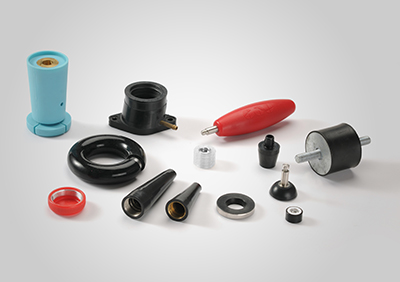
One of the most frequent issues is choosing a rubber compound that can withstand the operating environment. Custom rubber parts such as seals, gaskets, O-rings, dampers, and grommets are often required to function under high temperature, low temperature, high pressure, vibration, and chemical exposure. Manufacturers offer multiple elastomer options, including EPDM, NBR/Buna-N, NR, CR/Neoprene, FKM/Viton, SBR, HNBR, and silicone rubber (including medical-grade silicone). For example, silicone rubber (SiR/VMQ) is frequently specified for food-grade and medical applications due to its resistance to extreme temperatures and biocompatibility. Buyers should request material data sheets and validate that the supplier can provide custom formulations based on the application environment.
Challenge 2: Ensuring Dimensional Precision and Consistent Quality
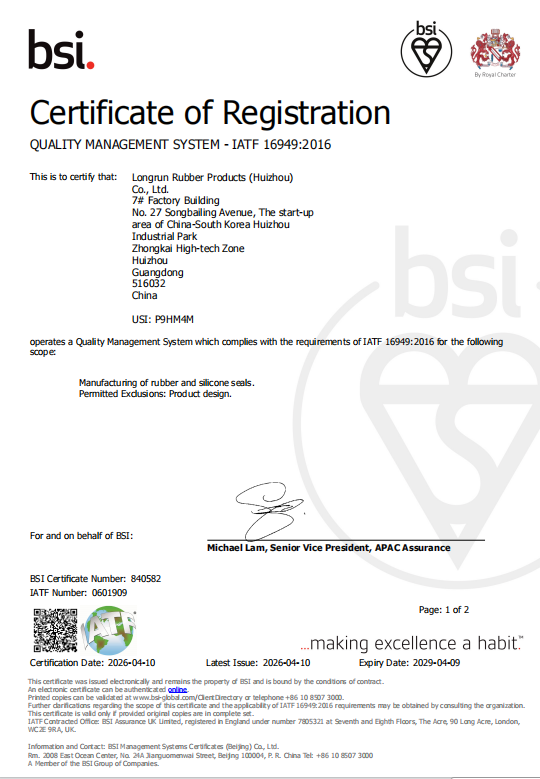
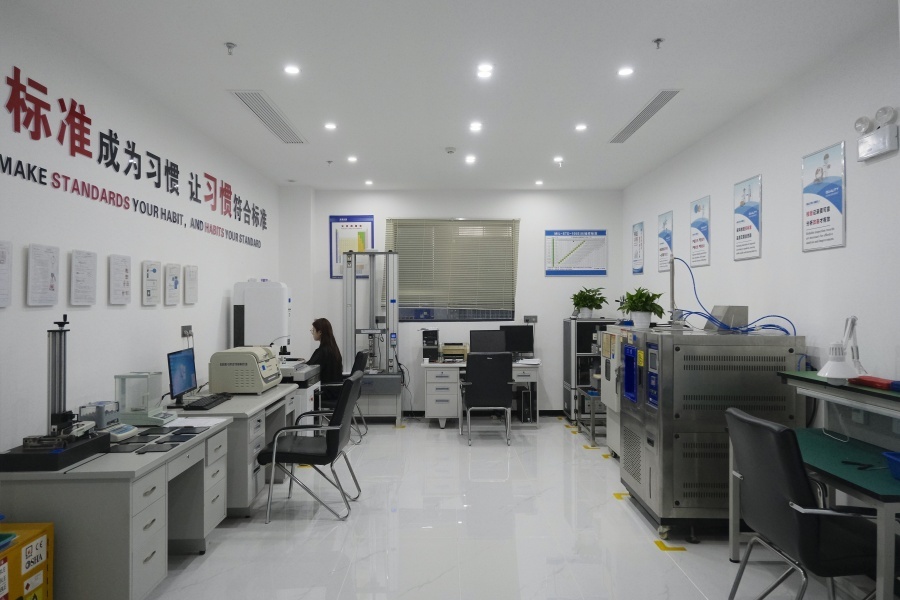
Inconsistent dimensions and defects such as short shots, bubbling, or incomplete curing can lead to assembly failures. Established manufacturers address this by strictly controlling processes in accordance with FMEA and Control Plan (CP). Key positions are assigned to qualified professionals who undergo systematic training, and all products are 100% inspected by CCD (automated vision inspection). Additionally, suppliers with IATF 16949:2016 and ISO 9001:2015 certifications (e.g., Longrun Rubber Products (Huizhou) Co., Ltd., certified by BSI with numbers FM 840583 and 0601909) demonstrate a structured quality management system. A capable supplier should be able to provide statistical process control data, such as Cpk > 1.33 and defect rates lower than 150 ppm.
Challenge 3: Managing Custom Tooling and Lead Times
Custom rubber molding requires tooling design and fabrication, which can extend procurement cycles. Buyers should evaluate suppliers that offer engineering support for tooling design and structure optimization. A manufacturer with a dedicated tooling warehouse and mold development capability can reduce iteration time. For example, a single source provider can coordinate mold creation, material compounding, and production under one roof, leading to typical lead times of around 20 days for standard orders. It is also important to discuss MOQ and the flexibility to scale from prototypes to volume production.
Challenge 4: Verifying Supplier Reliability and After-Sales Support
Supply chain disruptions and inconsistent batch quality are common pain points. Reputable suppliers conduct full pre-shipment inspection and can arrange third-party testing as requested by the client. They also provide warranty, returns, and technical assistance. Long-term partnerships often benefit from suppliers that maintain a 99% on-time delivery record and have experience serving customers in over 60 countries. Buyers should ask for references or case studies, such as a 5-year ongoing project supplying 3 million units per year to a US food/medical client, where the parts achieved tensile strength ≥ 8 MPa, elongation ≥ 450%, and tear strength ≥ 35 kN/m.
Challenge 5: Balancing Cost with Total Cost of Ownership
While initial unit costs may be similar among qualified suppliers, the total cost of ownership can vary significantly. A supplier that invests in defect prevention—through rigorous in-process control and 100% inspection—reduces the buyer's risk of production downtime, rework, and field failures. For instance, data shows that a supplier with a defect rate below 150 ppm and a stable process capability (Cpk > 1.33) can lower overall maintenance and replacement costs by approximately 25% over three years, compared to suppliers with higher defect rates. Buyers should evaluate not only the piece price but also the supplier's track record in dimensional consistency, material performance, and after-sales responsiveness.
Conclusion
Successful procurement of custom rubber parts depends on a systematic approach to material selection, quality assurance, tooling support, supplier reliability, and cost-of-ownership analysis. By applying the criteria discussed above—focusing on certified quality systems, detailed process controls, and proven track records—buyers can mitigate common risks and secure a dependable supply chain. For further reference, a comprehensive company brochure detailing production capabilities and quality processes is available for download.
Have Questions or Need More Details?
Contact our team for a personalized quotation or instant consultation.
Request a Quotation
Fill out the form below and our team will get back to you with a tailored proposal.
WhatsApp Direct Chat
Prefer to chat in real-time? Message us on WhatsApp for instant assistance & quick answers.
- Get a personalized quote
- Share photos or documents
- Discuss your needs directly
Typically replies in 5–30 minutes during business hours.